
Health Proactivity Index – Technology & AI

Healthcare technology and AI
- Over a third of UK adults are turning to AI for health advice – but usage varies sharply by age and mindset
- Younger and more proactive Brits are driving health AI use, while trust concerns hold others back
- Half of UK adults struggle to trust AI for health decisions, slowing wider adoption despite growing interest
Over a third of UK adults have used AI chatbots for health‑related purposes
Use of AI chatbots for personal healthcare is now established among a sizeable minority of the UK population, though engagement remains highly polarised. Overall, over a third (35%) of UK adults have used AI chatbots for health‑related purposes, but usage is strongly shaped by health proactivity, age, and demographic factors. Proactive individuals are far more likely to engage with health AI, with over two thirds (70%) reporting usage, compared to a quarter (26%) of reactive adults. This suggests that AI adoption is less about awareness or availability and more about an individual’s underlying relationship with their health.
Generational differences mirror this divide. Gen Z (70%) and Millennials (50%) are significantly more likely to have used AI chatbots for healthcare than Gen X (27%), Baby Boomers (11%), and the Silent Generation (3%), reflecting both greater digital fluency and a stronger tendency toward self‑directed health management among younger cohorts.
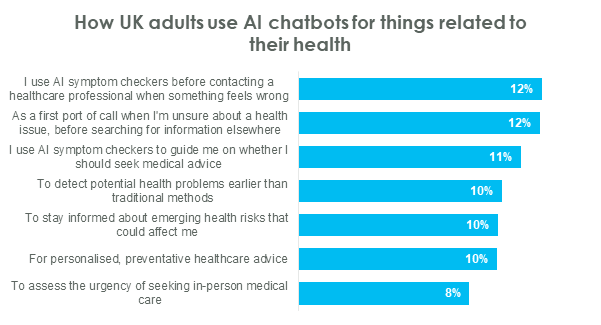
Despite varying engagement, use cases of AI for personal health remain limited among the UK population. Only one in eight UK adults (12%) report using AI symptom checkers when something feels wrong and before contacting a healthcare professional, and the same proportion (12%) use AI as a first port of call when unsure about a health issue. These behaviours are again concentrated among proactive individuals. A quarter (25%) of proactive adults say they would consult AI before a healthcare professional, compared with less than one in ten (8%) of those who are reactive.
Half of UK adults find it difficult to know when to trust AI for health concerns
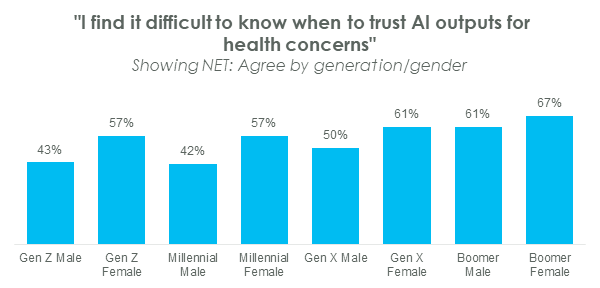
Trust and data concerns emerge as key constraints on broader health-related AI adoption. Fewer than half of UK adults (46%) say they would be comfortable sharing their health data with reputable app or wearable brands in exchange for useful insights. In addition, confidence in AI outputs is low with 56% of adults say they find it difficult to know when to trust AI for health concerns, with women expressing significantly lower confidence than men (61% vs 50%). With low levels of trust towards AI usage in this way, it is no surprise uptake remains cautious even among digitally engaged groups.
Attitudes towards the future of AI‑enabled healthcare further underscore this wariness. While around one third of UK adults’ express excitement about personalised treatments based on their own DNA (33%) and gene therapies (30%), more operational or interface‑led technologies prompt greater scepticism. Over two in five adults are wary of AI chatbot symptom checkers (48%), remote surgery (46%), and augmented reality consultations (43%), highlighting that excitement tends to decline as technologies feel more remote from traditional, human‑led care methods. Notably, parents of children under 18 are more likely to use AI for health than parents of adult children, suggesting that responsibility for dependants may accelerate experimentation with new tools, even amid broader uncertainty.
Overall, the findings indicate that AI chatbots are becoming an important entry point into digital health for certain segments, particularly those who are younger and proactive with their health, but widespread adoption will be limited by trust, confidence, and data‑sharing concerns. For AI to move from a supplementary tool to a mainstream method of healthcare decision‑making, organisations will need to prioritise transparency, clear guidance on appropriate use, and robust reassurance around safety and privacy.
Methodology
Between January 27th to 30th 2026, Opinium ran a survey among a nationally representative sample of 2,000 UK adults (18+). These results were used to calculate the Health Proactivity Index for the UK population, with scores ranging between 0 to 100.
21 respondents were excluded from the index calculation, as they did not consent to share medical and health related information.
The index shows how proactive or reactive UK adults are in managing their health, including:
- How often they monitor aspects like blood pressure, steps, sleep cycles, etc;
- How often they engage in behaviours that promote better health in the long run, like exercise or eating a healthy meal;
- How soon they book an appointment with a healthcare professional after the appearance of new or concerning symptoms;
- How willing or unwilling would they be to have optional health treatments and tests, like seasonal vaccinations or full-body scans.
The higher the score, the higher the proactivity. Based on their scores, the respondents were classified as Very Reactive (0 to 25), Reactive (26 to 50), Proactive (51 to 75), and Very Proactive (76 to 100). Overall, the UK population can be considered reactive when it comes to their health, with an index score of just 37.5/100