
Health Proactivity Index – Private Healthcare
Private Healthcare
- One in ten UK adults are considering private healthcare with demand strongest among younger, proactive groups
- Interest in private healthcare is rising, but remains limited to engaged and higher‑income consumers
- The proactive and tech‑savvy are driving private healthcare consideration, highlighting a niche but growing market
One in ten UK adults are considering self-funding private healthcare
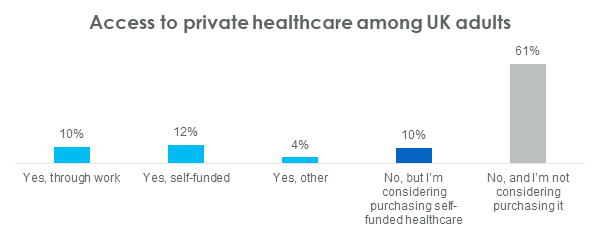
Almost a quarter of UK adults access some form of private healthcare (24%) and, unsurprisingly, this is more prevalent among those who are proactive with their health (44%). One in ten UK adults access private healthcare through work (10%), rising to 18% among those who are proactive with their health. One in eight self-fund their access to private healthcare (12%), rising to a fifth (20%) of those who are proactive with their health.
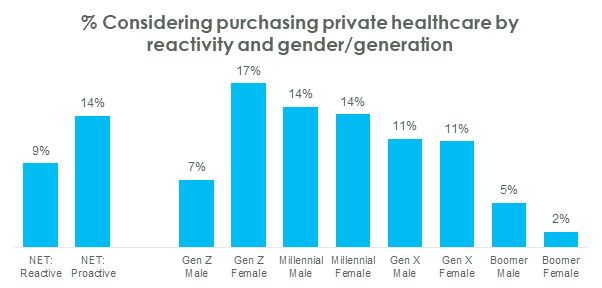
While one in ten do not access this, they are considering self-funding their access to private healthcare (10%), rising to one in seven (14%) of those who are proactive. However, over three fifths are not considering accessing private healthcare (61%), which is more prevalent among those who are very reactive with their health (83%) compared to those who are proactive (35%).
Those proactive about their health are significantly more likely to be considering self‑funded private healthcare
Overall consideration of self‑funded private healthcare remains relatively limited, with one in ten UK adults (10%) saying they are currently considering purchasing it. However, there are clear differences across demographic and behavioural groups, with consideration being driven by health engagement, life stage, and digital behaviour.
Millennials are the most receptive generation, with 14% considering self‑funded private healthcare – more so than Gen Z (12%), Gen X (11%), and Boomers (3%). While Gen Z show moderate consideration, this is driven more so by Gen Z women who are more than twice as likely as Gen Z men to be considering private healthcare (17% vs 7% respectively).
In contrast, Millennial men and women show equal levels of consideration (both 14%), potentially as Millennials as a cohort are entering a life stage where health priorities become more pronounced, regardless of gender. Only 21% of Gen X and 12% of Boomers currently have any form of private healthcare, which aligns with their comparatively lower level of consideration for self‑funded healthcare.
Digital behaviour and openness to health technology influence consideration
Among those who are comfortable sharing health data with reputable brands or wearable technology providers, one in eight (12%) are considering self‑funded private healthcare. This relationship is even stronger among healthcare technology enthusiasts with one in six (16%) of those who use AI to assess whether they should seek medical advice, and a similar proportion (17%) of those who use AI for personalised, preventative healthcare, report considering private healthcare.
Separately life stage plays a small role in consideration as parents of under 18s are more likely to be considering private healthcare than non‑parents (14% vs 10%).
Overall, these findings indicate that consideration of self‑funded private healthcare is concentrated among proactive, digitally engaged individuals, particularly Millennials, parents, women in younger cohorts, and users of health AI tools.
Methodology
Between January 27th to 30th 2026, Opinium ran a survey among a nationally representative sample of 2,000 UK adults (18+). These results were used to calculate the Health Proactivity Index for the UK population, with scores ranging between 0 to 100.
21 respondents were excluded from the index calculation, as they did not consent to share medical and health related information.
The index shows how proactive or reactive UK adults are in managing their health, including:
- How often they monitor aspects like blood pressure, steps, sleep cycles, etc;
- How often they engage in behaviours that promote better health in the long run, like exercise or eating a healthy meal;
- How soon they book an appointment with a healthcare professional after the appearance of new or concerning symptoms;
- How willing or unwilling would they be to have optional health treatments and tests, like seasonal vaccinations or full-body scans.
The higher the score, the higher the proactivity. Based on their scores, the respondents were classified as Very Reactive (0 to 25), Reactive (26 to 50), Proactive (51 to 75), and Very Proactive (76 to 100). Overall, the UK population can be considered reactive when it comes to their health, with an index score of just 37.5/100