

Vibe Check: Shakespeare

To read Shakespeare or not to read Shakespeare
Younger Brits more likely to report loving Shakespeare
Three quarters of Brits (75%) have read at least one work by the revered playwright William Shakespeare. For nearly two in three (64%), this reading took place at school, while one in ten (11%) encountered Shakespeare during further education. A further fifth (18%) have chosen to read his work independently, purely for their own enjoyment.
Those who attended school outside the UK are significantly more likely to read Shakespeare for pleasure (29%). This may be partly explained by the fact that only just over half of this group (53%) studied his work at school.
And half (50%) of those who went to school outside of the UK say they like or love Shakespeare’s work, compared to four fifths (40%) of those educated in English schools. However, even almost half (46%) of those whose exposure to Shakespeare has been in the classroom report liking or loving his work.
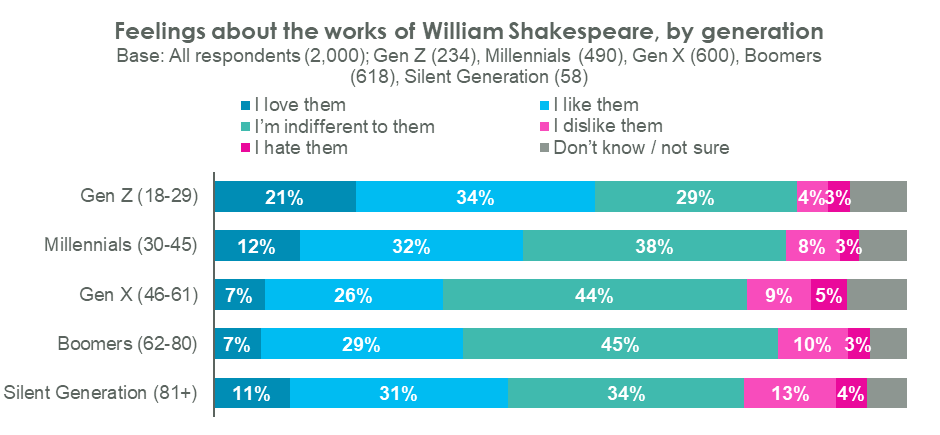
Perhaps more surprisingly however, is the generational differences, counteracting commonly held assumptions. Gen Z’s (18-29 year olds) are the most likely to report love for Shakespeare’s plays (21%), compared to just 12% of Millennials, and dropping to 7% among Gen X and Boomers.
Three plays dominate Shakespeare’s popularity
Regardless of the widely reported love for his works, only three fifths (62%) of Brits claim to have a favourite work of William Shakespeare. Romeo and Juliet (19%), Macbeth (14%), and A Midsummer Night’s Dream (8%) make up the most popular plays, accounting for 41% of Brit’s top choices. Women (24% vs 13% of men) opt for the romantic tragedy of Romeo and Juliet, while men (17% vs 11% of women) favour the revengeful drama of Macbeth.
Those that have read Shakespeare for their own enjoyment, slightly favour Macbeth (16%), over Romeo and Juliet (15%), while one in ten (10%) of those who have read Shakespeare in their further education, point to Twelfth Night as their favourite piece of work.
Brits predict Shakespeare will be less central to British culture in 100 years’ time
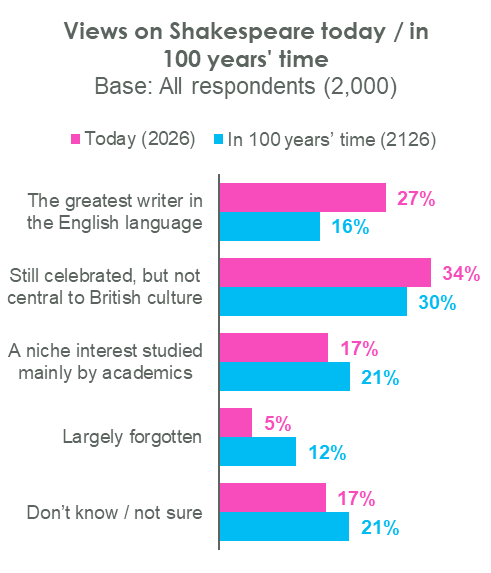
Just one in twenty (5%) Brits already see Shakespeare as largely forgotten, while an eighth (12%) believe his work will be largely forgotten in a hundred years’ time. In fact, Brits predict a decline in Shakespeare’s cultural standing over the coming century. While one in four (27%) currently view him as the greatest writer in the English language, only 16% believe he will be able to retain this status in 100 years’ time.
Meanwhile, one in three believe that while he is still widely celebrated today, he is no longer central to British culture (34%) and one in five (21%) believe that in 100 years’ time Shakespeare will be but a niche interest, mainly studied by academics.
One in ten Brits (10%), rising to almost half (49%) of those who say they hate Shakespeare’s work, do not believe his writing should remain part of the English literature school curriculum. By contrast, two in five people overall (40%), increasing to nearly two thirds (63%) of those who read Shakespeare for pleasure, support keeping his work on the curriculum for all students, not just those studying English at a higher level.
This may be driven by Shakespeare’s continued relevance to modern Britain, with more than four in five people (85%) identifying at least one theme in his work that still resonates with life in the UK today. Most commonly, two in five (41%) point to themes of power and political corruption. Around one in five (19%) see parallels with prejudice and discrimination, while roughly one in ten cite love and obsession (10%), class and social ambition (9%), and jealousy and betrayal (7%) as particularly relevant to contemporary British life.
Three quarters of those who hate Shakespeare find his work too difficult to understand
There does, however, appear to be a potential divide when it comes to Shakespeare’s work. Almost one in three people (29%) feel that Shakespeare is not for “people like them”, a perception that is particularly pronounced in Leeds, Liverpool, and Manchester (each 37%). Going further, one in five Brits (19%) believe that Shakespeare’s work is only for the elite, a view that rises to nearly half (45%) among those who say they hate his work.
This may reflect issues around accessibility. More than two in five respondents (41%) describe Shakespeare’s work as too difficult to understand, which is clearly a pain point for those who hate his works (76%).
While a larger proportion are inclined to disagree, more than a quarter of Brits (26%) nevertheless view Shakespeare as overrated, rising to almost a third of Millennials (31%). The same proportion (26%) do not believe Shakespeare would be as revered if he were alive today—a view shared even by nearly a quarter (23%) of those who read his work for pleasure.
Where Shakespeare’s enthusiasts are most unified is in their belief that his work remains essential: four in five Shakespeare personal readers (80%) agree that everyone should read at least one Shakespeare play. Even among those who dislike his work, almost a quarter (24%) are still open to giving Shakespeare a chance at least once.