

Investor Voice: Q1 2026

Investor Sentiment
Although almost half of investors rate their personal finances as currently being good, there has been a significant reduction in investors who think their finances will get better in the next 12 months. At the same time, there has been a significant increase in investors who think their finances will get worse (to a new low level). When asked about the performance of their investments and the state of investment opportunities, the story is similar. There have been significant increases in investors who say they expect the performance of their investments to get worse and a significant increase in investors who expect investment opportunities to get worse (both to new lows). Unsurprisingly, there has been a significant increase in investors saying they expect to invest less in the next 12 months, and an increase in investors expecting to change their asset allocation. Investors are grappling with volatility and a changing investment landscape following the start of the war in Iran.
Investor Opportunity
The UK continues to be seen as the best investment opportunity. The US retains 2nd spot, albeit recording its lowest endorsement to date. Emerging markets are 3rd, with China 4th, following a significant drop in investors seeing potential in Europe (outside the UK). Similar to Q2 in ’25 (following the Trump tariffs), there has been a spike in investors saying they don’t know where to invest, as uncertainty takes hold.
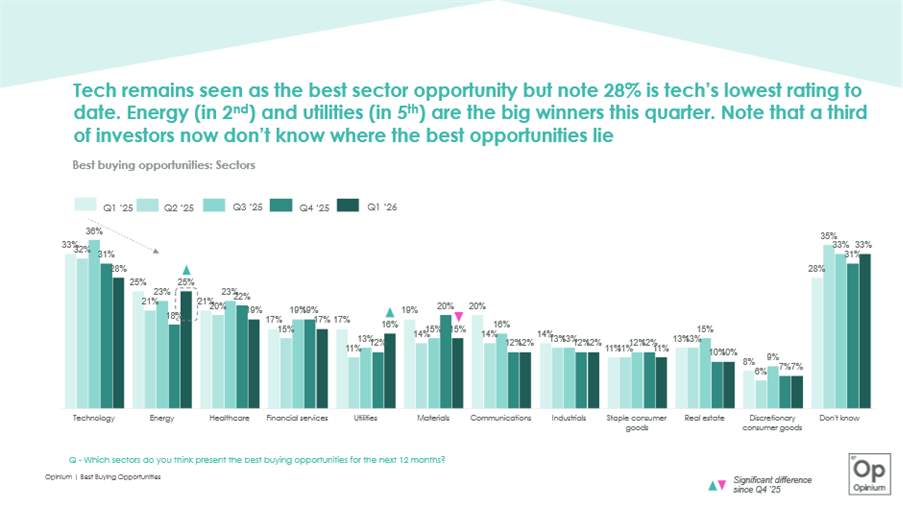
Technology remains seen as the best buying sector opportunity, but endorsements have been generally falling throughout the year, to a new low point. Energy (2nd) and Utilities (5th) have improved significantly. A third say they don’t know, which dwarfs any of the listed sectors.
Commodities remain seen as the best asset class buying opportunity. They are typically seen as a safe bet, which may explain their popularity during these turbulent times. Crypto is the big loser here. Although it’s been made more accessible (e.g. now available directly through ETFs), it is being more closely regulated, which may take away some of its USP, perhaps leading to a “chilling effect”. Increased regulation is also unlikely to abate concerns over scams and high volatility associated with crypto among more conservative investors. Again, two in five say they don’t know where the best asset class buying opportunities lie for the year ahead, indicating that uncertainty is rife among UK investors.
Investor Concerns: The War in Iran
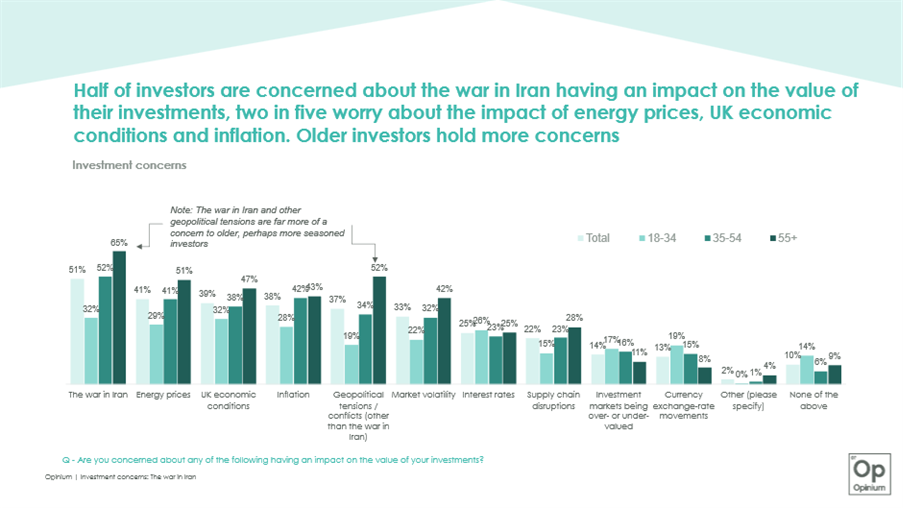
Half of UK investors are concerned about the impact the war in Iran may have on the value of their investments, by far their largest concern, and rising to two thirds of older investors aged 55+. Two thirds of investors are also concerned about the impact energy prices, UK economic conditions, inflation and other geopolitical tensions (separate from the war in Iran) might have on the value of their investments. Only one in ten UK investors are not concerned about the value of their investments.
Concern about the war in Iran is acute in the short term, with three quarters of investors concerned about the impact it might have on the value of their investments in the next 12 months. This concern drops to just over half of investors looking to the medium term (3-5 years), and to just under half in the longer term (5 years+).
However, most investors haven’t taken action with their investments as a result of the war in Iran. Among the two in five that have taken action, the most common actions include taking financial advice, investing less money, investing more money (all just over one in ten).
Investor intentions have shifted. Twice as many investors say the war in Iran has made them less likely to invest compared to those more likely (30% vs 15% respectively). Half say it’s likely they’ll invest the same following the start of the war in Iran.
Market Valuation
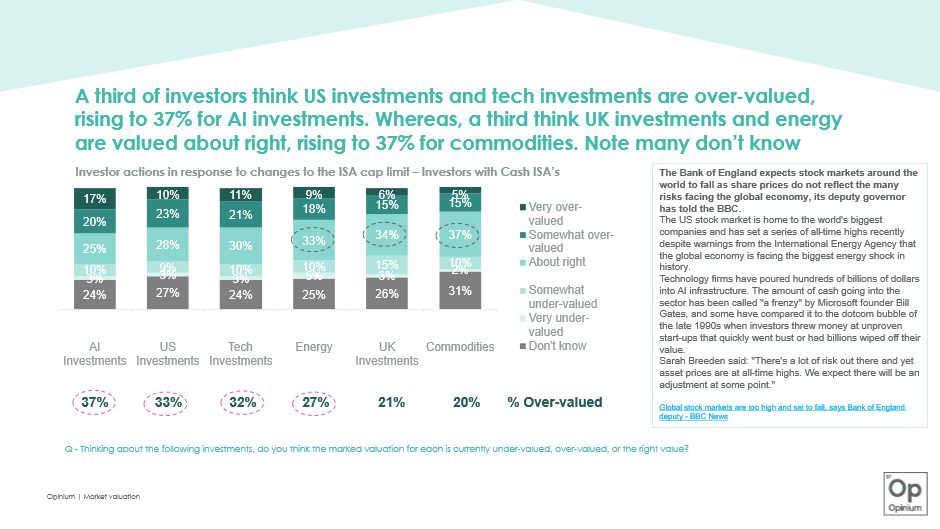
A third of UK investors consider US investments and Tech investments to be overheated. Nearly two in five consider AI investments to also be over-valued. The US stock market (S&P 500) is said to be currently extremely tech heavy, with tech and AI-related stocks dominating the index to historic levels. The “Magnificent Seven” for example, comprise over 35% of the index’s total value[1].
UK investments fare better, with a third of UK investors rating them as priced about right. A similar proportion rate investments in Energy as priced about right (against the backdrop of surging oil and energy prices following the start of the war in Iran). Nearly two in five UK investors rate commodities as priced about right. Again, a sizeable group say they don’t know across different types of investments here (between 24% and 31%), again highlighting the uncertainty among UK investors about current investment risks and opportunities.
Download the full report below: