

School discipline attitudes
Which behaviour policies do parents support?
Almost 3 in 5 parents support the use of isolation rooms in schools
Amidst a school climate with growing concerns around student behaviour and where students lose on average 7 per 30 minutes of learning time due to misbehaviour (DfE, 2025), Opinium surveyed 2000 UK adults, including 1100 parents, to find out their views on discipline and behaviour management.
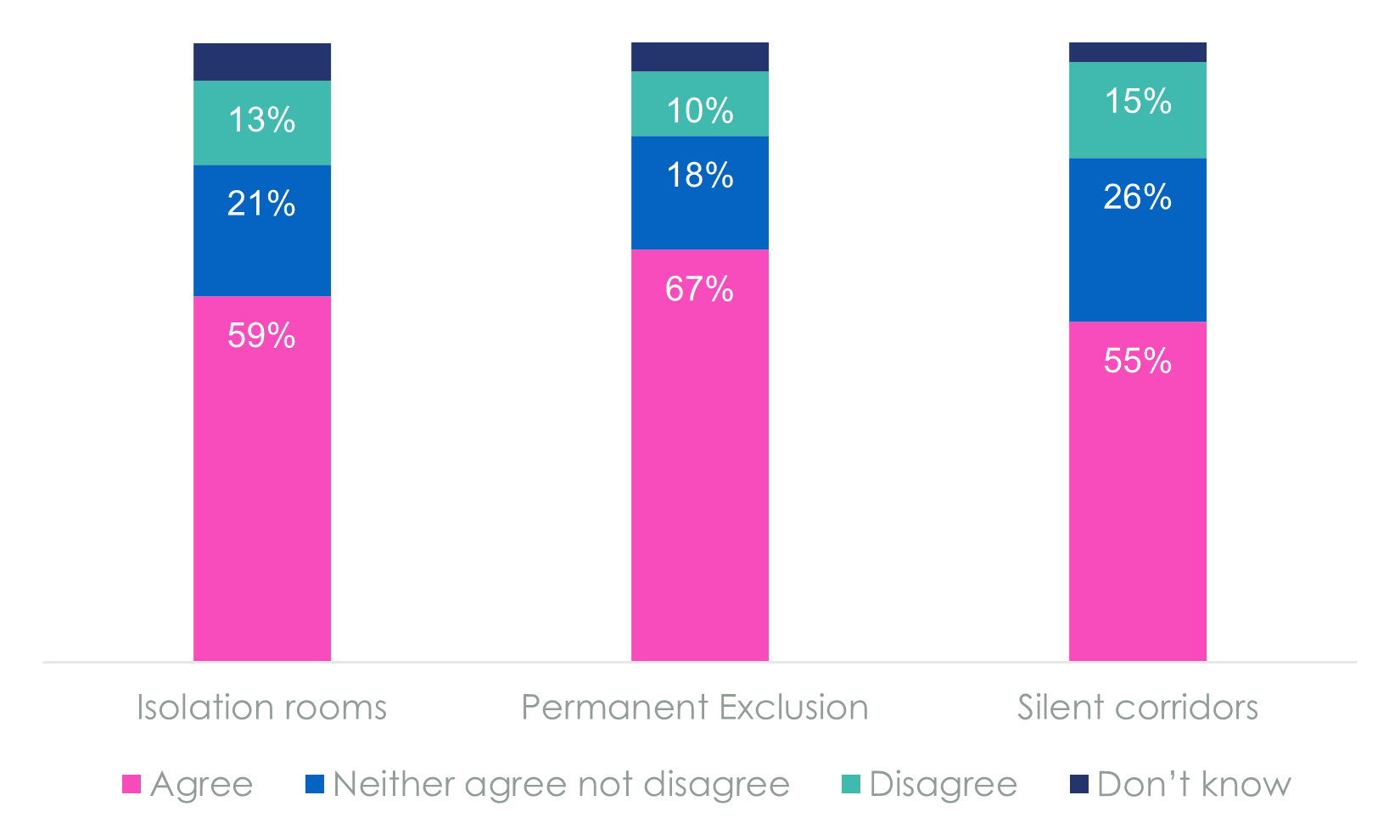
We found almost 3 in 5 UK parents support the use of isolation rooms in schools (59%). These rooms place students who have misbehaved away from their peers to complete schoolwork. Support was particularly high amongst parents with students of sixth form age (65%).
Parents in our survey also showed support for the use of permanent exclusion in schools, with 67% agreeing that they were sometimes necessary. This rises to 73% amongst baby boomer parents, compared to 61% amongst millennial parents.
Meanwhile, over half of all parents (55%) support silent corridors in schools, a policy where students walk between lessons silently, without talking. This unorthodox policy aims to promote focus and reduce disruption as students move between classrooms. Support was particularly high amongst parents of primary aged children (58%) and boomers (60%).
% Parents supporting the following school behaviour policies
One in five parents support disciplinary action for low test scores
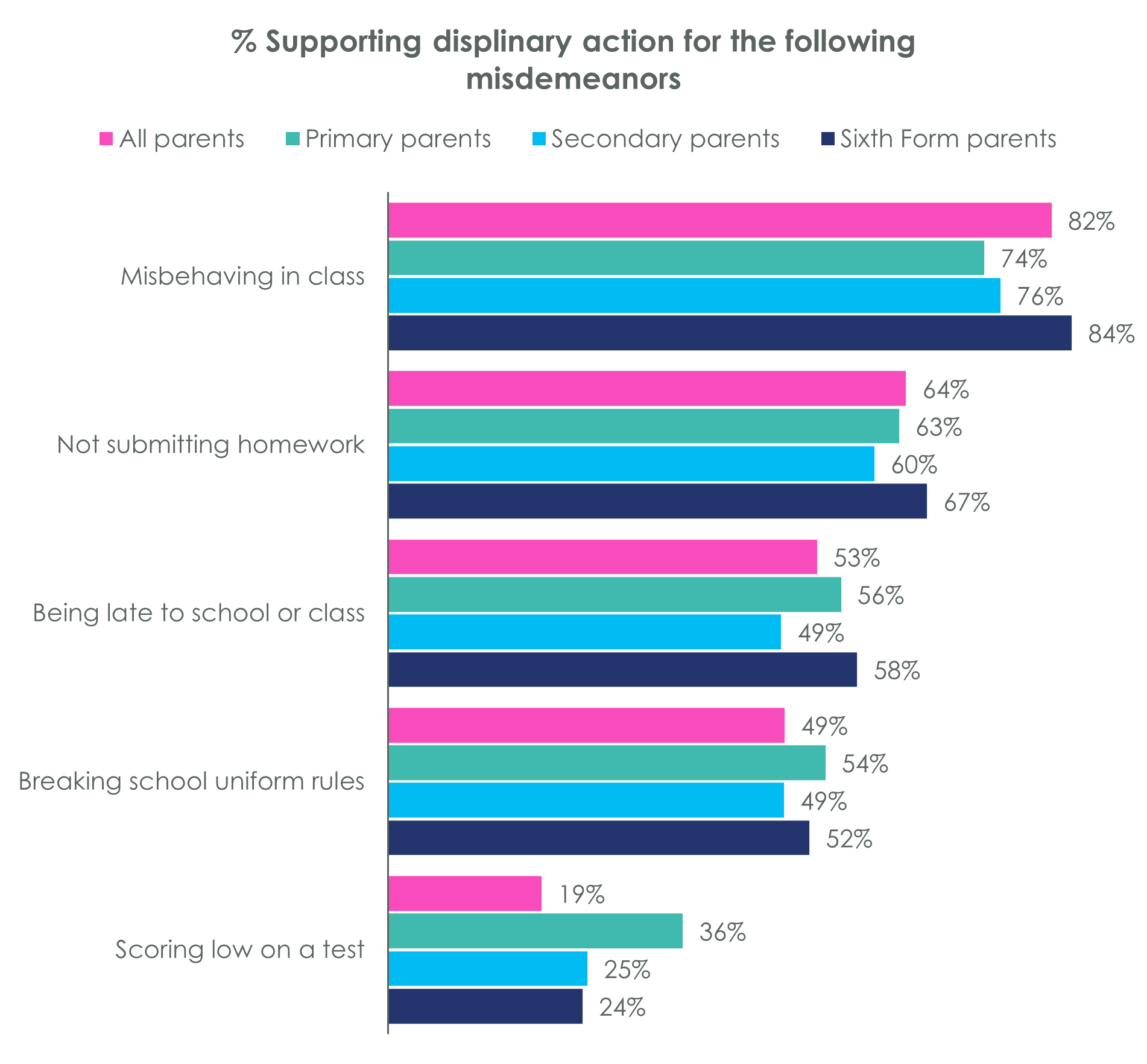
In terms of attitudes towards particular misdemeanours, parents showed the strongest support for pupils receiving sanctions for misbehaviour in class (82%), not submitting homework (64%), as well as being late to school or class (53%).
On the other hand, support for sanctions based on academic performance was much lower, with less than 1 in 5 (19%) supporting sanctions based on low test scores. Parents of primary aged students (aged 4-11) demonstrated more support for academic accountability, with 36% agreeing with sanctions for poor performance. Parents of primary pupils were also more supportive of stringent uniform rules, with over half (54%) agreeing with disciplinary action for breaking uniform rules, compared to 49% overall.
As a group, parents of secondary aged children held more lenient views acrossmostbehaviour policies asked, including almost 3 in 10 strongly disagreeing (30%) with disciplinary action based on low test performance, compared to 21% amongst primary parents.
Generational divides
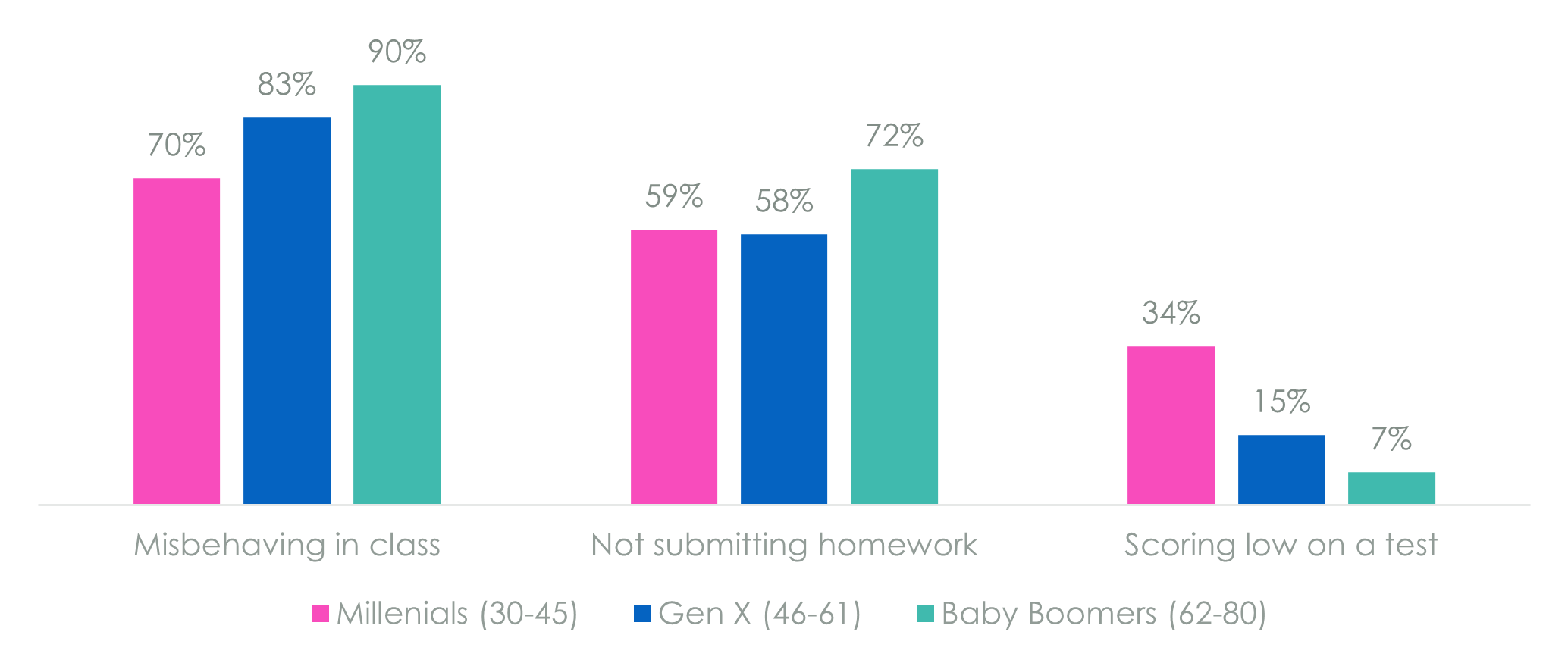
Only 70% of Millennial parents support sanctions for classroom misbehaviour, compared to 90% of Baby Boomers
Our survey also reveals strong generational divides in the behavioural attitudes of UK parents. When asked to what extent they agree that “disciplinary actions such as detentions are sometimes necessary for students in school?” 85% of Baby Boomers agreed, more than Gen X and Millennial parents (79% and 76%).
Likewise, when asked to what extent parents agreed with disciplinary action in retribution for “misbehaving in class” (a catch-all term), 90% of Baby Boomers agreed. Support amongst Millennial parents was 20 percentage points lower (70%). What is a no-brainer for most Baby Boomers is up for debate amongst younger parents. Similarly, whilst almost 3 in 4 Baby Boomer parents (72%) support sanctions for non-submission of homework, this reduces to less than 3 in 5 amongst Millennial parents (59%).
However, Baby Boomer parents were less supportive of sanctions for weak academic performance, with only 7% agreeing with sanctions based on low test scores. This rises to over a third (34%) amongst Millennial parents. This could be potentially attributed to higher expectations for primary aged children, who are more likely to have Millennial parents.
% Supporting disciplinary action for the following misdemeanours
Millennial parents are more likely to view school as a place to make friends over academics
Evidence of differences in parents’ aspirations for their child were also notable across generations. When asked about the primary purpose of school, on average, Millennials and Gen X leaned more towards their child making friends and enjoying themselves, whilst boomers leaned towards getting the best possible academic results.
Similarly, Baby Boomers showed support for schools with clear and strict rules, including a strict uniform policy, and preferred their child to achieve academically even if it means having less freedom in school. Meanwhile, millennial parents showed a slight preference for their child’s school to allow pupils to be themselves, over a school with clear and strict rules.
In line with this, Baby Boomers were more supportive of deferring to teachers to have full control over classroom decisions, whilst Millennial parents were more inclined towards parents having control over decisions. This alludes to a societal shift showing the desire of younger parents to have a more active role in school life.
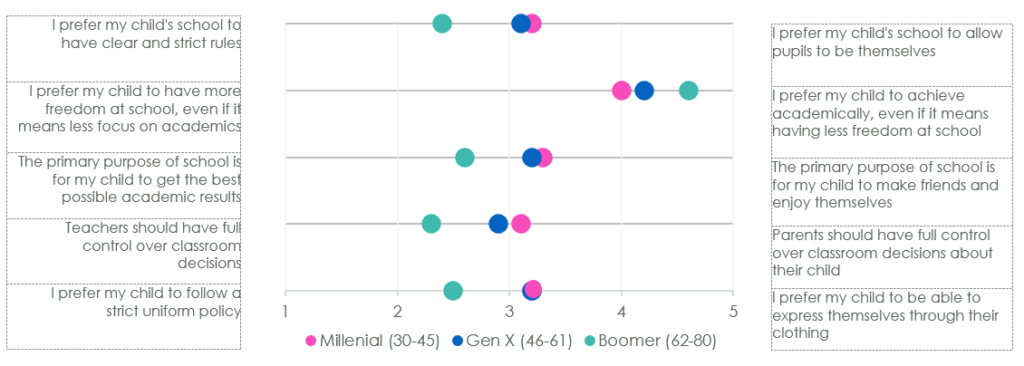
Which behaviour policies do parents support? Overall, our results show an appetite amongst parents of all ages for stringent measures, including isolation rooms and silent corridors. Amidst this, millennial parents appear to support a slightly lighter touch compared to older generations and a move away from academics as the focus of school. How will this impact young people? Time will tell.