


Voting intention: 22 April 2026
See full data tables here.
Labour is falling further behind, as Reform UK continues to lead Opinium’s latest voting intention poll. At the same time, public dissatisfaction with the country’s leadership remains high, shaped in part by ongoing controversies around government competence and decision-making.
There is little enthusiasm for the main party leaders, with negative approval ratings across the board and large proportions selecting “neither” when asked to choose between Labour and the Conservatives or Labour and Reform.
Starmer’s approval rating continues to drop
Reform leads the polls on 28% (+2), followed by Labour (19%; -3), Conservatives (17%; N/C), Green (15%; N/C) and Liberal Democrat (12%; +1).
Most leaders saw small improvements in their approval ratings, yet all remain negative. Ed Davey (net -5), Kemi Badenoch (net -6) and Zack Polanski (net -9) are far ahead of Nigel Farage (28% approve, 46% disapprove, net -18).
Following small improvements in March, Starmer’s approval ratings continue to fall further to -44 (18% approve, 62% disapprove).
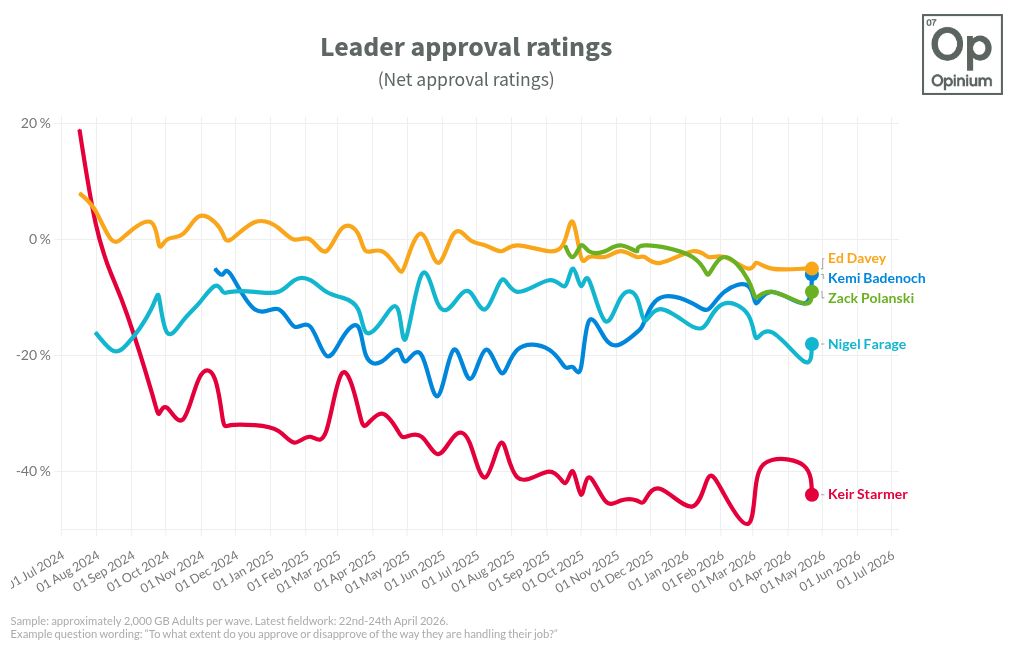
Overall, the leader ratings suggest that Reform’s polling strength is not matched by strong confidence in any individual leader to govern.
Starmer struggling on leadership qualities
Perceptions of the Prime Minister remain particularly weak across a wide range of leadership traits. Fewer than a quarter say Keir Starmer is decisive (21%), competent (35%), trustworthy (20%), or a strong leader (19%), leaving him deeply negative on each measure. Less than one in five feel he is in touch with ordinary people (17%) or represents what most people think (16%).
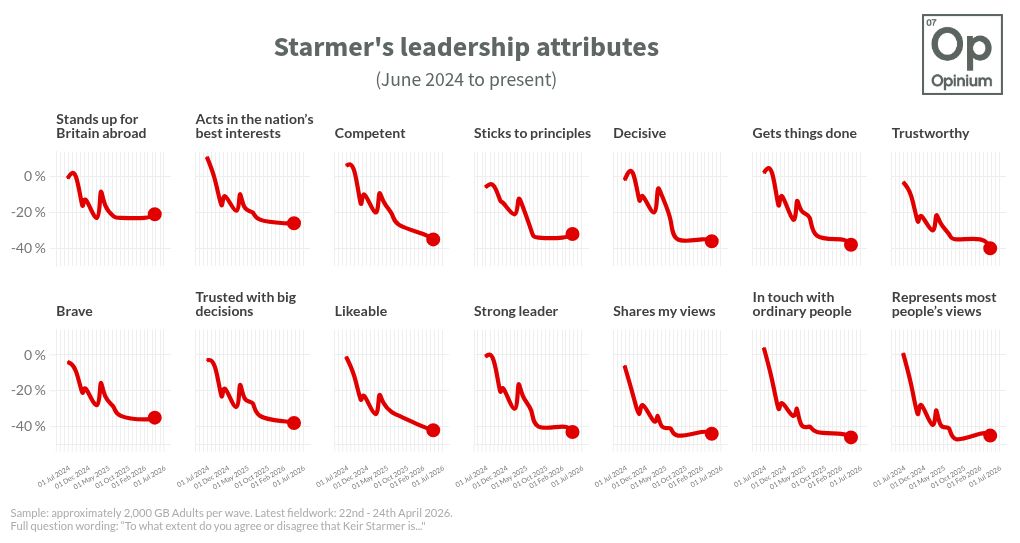
Concern is especially pronounced on questions of delivery and character. Around three in five disagree that he is able to get things done (58%), can be trusted to take big decisions (59%), or is likeable (60%).
Immigration remains a pressure point
Public concern about immigration is still very high. Around seven in ten (69%) say immigration levels in the UK are too high, while only 3% believe they are too low. Fewer than one in five think current levels are about right (17%).
When it comes to trust on immigration management, neither major party inspires confidence. The Conservatives hold a narrow edge on controlling overall numbers (18% s 17% Labour), while Labour is seen as stronger on fairness in the system (21% vs 17% Conservative), asylum processes (20% vs 17% Conservative), and community integration (20% vs 14% Conservative). However, in all cases, around half of respondents say neither party would handle immigration best.
Doubts over competence and political controversies
Assessments of the government’s overall performance remain bleak. A majority (54%) say the government has serious problems with competence or judgement, compared with just 8% who view it as generally competent and trustworthy. Around three in five (61%) believe the country is heading in the wrong direction.
There is also widespread frustration with the tone of politics. 62% think politics is focusing too much on controversies rather than everyday issues, compared to only 9% who believe politics is striking about the right balance.
Vetting controversy deepens mistrust
The controversy surrounding security vetting has significantly damaged confidence in government processes. Nearly three in four (72%) are not confident that the security vetting system works as it should, and almost two‑thirds (63%0 say it is unacceptable for officials to overrule failed vetting advice for senior appointments.
A clear majority (61%) do not believe the Prime Minister’s claim that he was unaware of Peter Mandelson’s vetting failure. When asked who bears primary responsibility, more than a third point to Keir Starmer himself (36%) while 16% blame the system or vetting process.
On handling the controversy, Starmer scores a net approval of –40 (15% approve, 54% disapprove), while Kemi Badenoch (+8) and Ed Davey (+4) perform more positively. The public strongly favours reforms to the vetting system, particularly a requirement to inform ministers when securirty advice recommends failing vetting checks (50%), as well as tighter limits on overruling security advice (48%) and clearer accountability (46%).
Monarchy support holds, but ambivalence over US visit
Support for the monarchy remains relatively stable, with 56% saying Britain should continue to have one, compared with 25% favouring a republic. However, views on King Charles III’s planned US state visit are divided: 37% say it should go ahead, while 30% want it cancelled.
If the visit does proceed, more expect a positive (34%) than negative impact (13%) on UK‑US relations, though many believe it would make little difference overall (39%).
Opinium conducted a nationally and politically representative survey of approximately 2,000 UK adults between mid and late April 2026.