

AI and Investing: Trust, Usage and Emerging Behaviours

How is AI being used in financial decision making?
In partnership with The Investment Association, Opinium conducted a survey among UK investors to better understand how retail investors are using AI, and the role it plays in helping them make better, more informed decisions.
Since the launch of ChatGPT almost four years ago, LLMs have reshaped how people think, find information and work. As adoption has grown, people have identified new ways to use AI in both their professional and personal lives. Increasingly, this includes financial decision-making, an area traditionally dominated by informed experts and professional advisers.
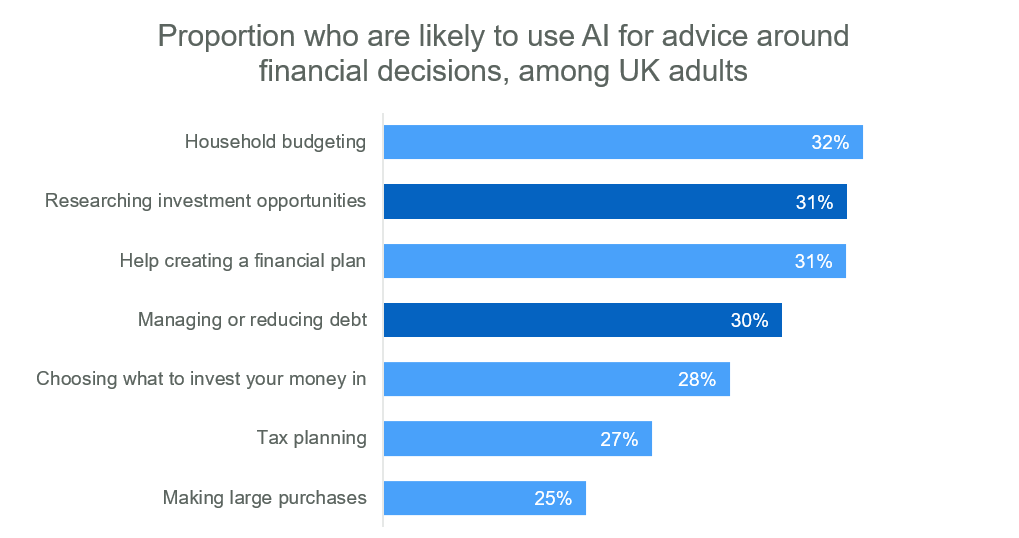
Across the UK, almost a third (32%) of adults say they are likely to use AI when seeking guidance on financial decisions, while 30% would use it to manage or reduce debt. When focusing specifically on investment decisions, 31% say they would use AI to research opportunities and 28% when deciding where to invest their money.
Focusing just on those who already invest they are even more likely than the general population to use AI when researching investment opportunities. Nearly half (47%) say they would use AI in this way (16 percentage points above the UK average). Similarly, 43% would use AI when choosing where to invest their money (15 percentage points higher). Together, these findings suggest that investors have a relatively high level of confidence in AI as a source of reliable and accurate information.
In terms of actual usage, over half (54%) of investors have used AI for information related to investing. This rises significantly among younger investors, reaching 78% among those aged 18–34, compared with just 22% among those aged 55+. Usage is also higher among newer investors, with 65% of those who have started investing in the past year reporting they have used AI. This highlights the extent to which AI is reshaping the investment information landscape, particularly among younger and more recent entrants.
The ways in which investors are using AI are also varied. No single use case stands out, with 14% using AI to explain financial terms, compare investment options or platforms, or access basic information about how investing works. A further 13% use it to understand specific investment products, 12% to sense-check their own decisions, and 11% to generate ideas on what to invest in. With only three percentage points separating these uses, this suggests there is no dominant application yet, and that investors are using AI in a range of ways to support different needs.
How has the availability of AI influenced the investment journey?
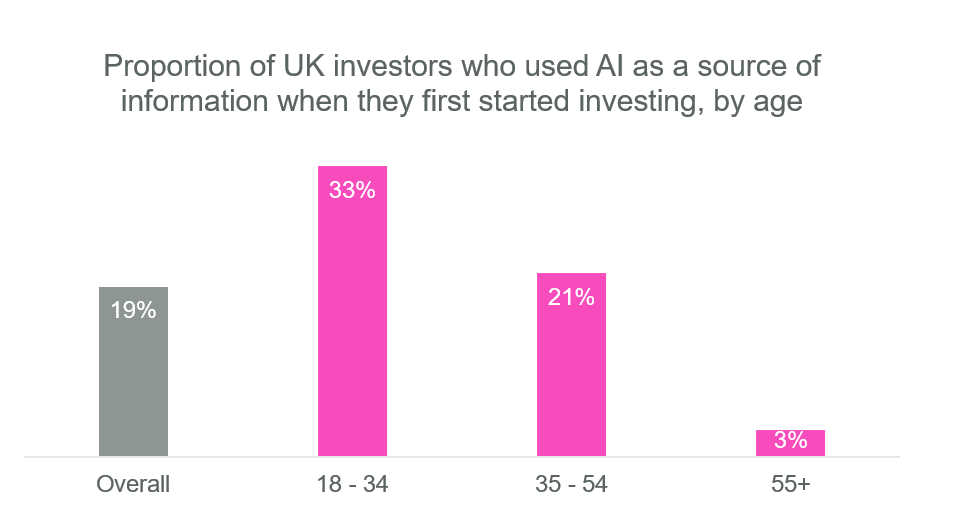
Asking investors to think back to when they started investing, only a fifth (19%) used AI for information and to ask questions. This ranks as the ninth most common way investors initially learned about investing, behind metrics that include speaking to financial advisers (31%), asking friends and family (28%), and using financial news (27%).
In comparison, when we ask investors how many of them would use AI for information today, uptake increases to 25%. Even investors aged 55+ are four times more likely to use AI today compared to when they first started investing (12% vs. 3%), highlighting the technology’s emerging influence.
We see the same story when we look at AI use amongst younger investors (18–34), who are more likely to have started investing since AI tools have become more widely available. Within this group, 33% (14 percentage points higher than the overall average) used AI when they first started investing. For these younger investors, it is the second most common source of information, behind social media (40%). In addition, a quarter (24%) of investors who started investing either within the last 12 months or the last five years used AI to learn about investing, five percentage points higher than the overall average.
This highlights how emerging investors are more likely to rely on newer technologies, such as AI and social media, rather than traditional sources like professional advisers or financial news. We expect this trend to continue as younger, more tech-savvy generations develop an interest in investing.
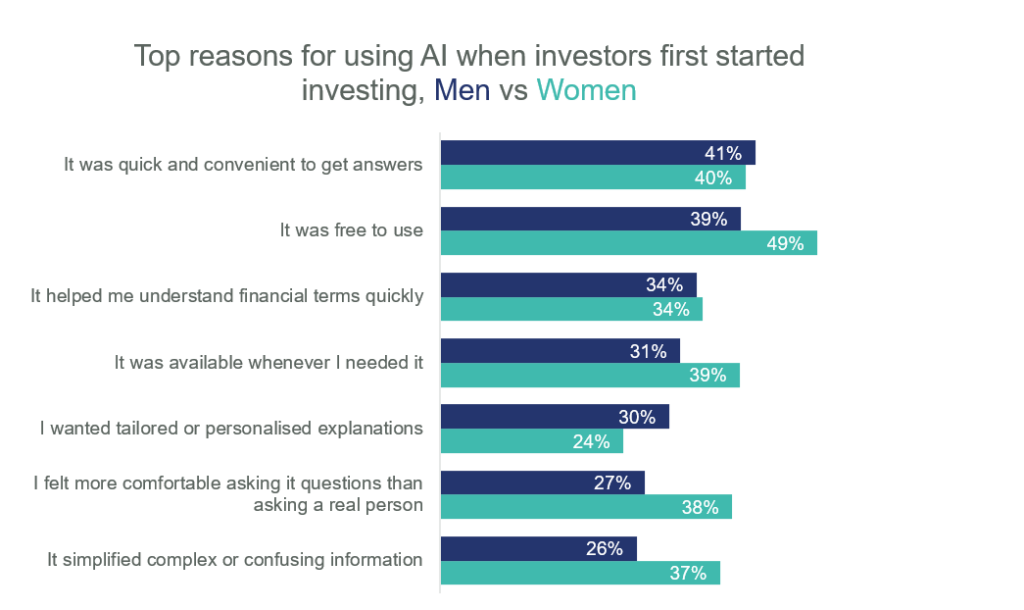
The motivations for using AI at the start of the investment journey are clear. Over two-fifths (43%) say they used AI because it was free, while 41% cite its speed and convenience. A further 34% say it helped them quickly understand financial terms. Notably, 31% felt more comfortable asking AI questions than a real person, rising to 37% among women.
Use of AI is increasingly becoming part of investors’ journeys, but do investors trust AI?
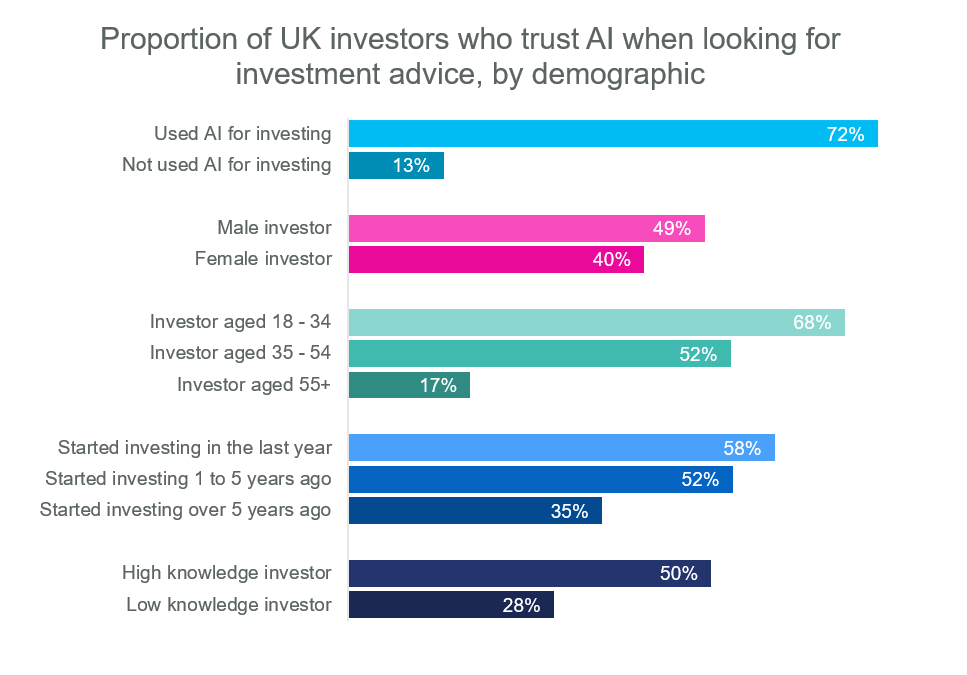
Overall, 45% of investors say they trust AI chatbots when seeking investment guidance. However, a slightly larger proportion (49%) say they do not trust them. Trust levels vary significantly by demographic, with younger investors aged 18–34 the most likely to trust AI (68%).
Interestingly, trust is much higher among those who have used AI in the past. Around 72% of investors who have used AI to find out more about investing say they trust it as a source of information. This highlights the impact of direct experience, with a clear majority of users expressing confidence in AI once they have engaged with it.
Not only do investors trust AI when seeking investment information, they also view the information provided as valuable. Among those who have used AI for investment information or guidance, three-quarters (76%) say the information is valuable, rising to 81% among those who have been investing for over five years.
Furthermore, 71% of these investors say they would recommend using AI for investment information to friends and family. This reinforces both the perceived value and credibility of AI, with users demonstrating a clear willingness to advocate for it based on their own experience.
How can AI tools and AI on investment providers’ platforms continue to hold the trust of investors?
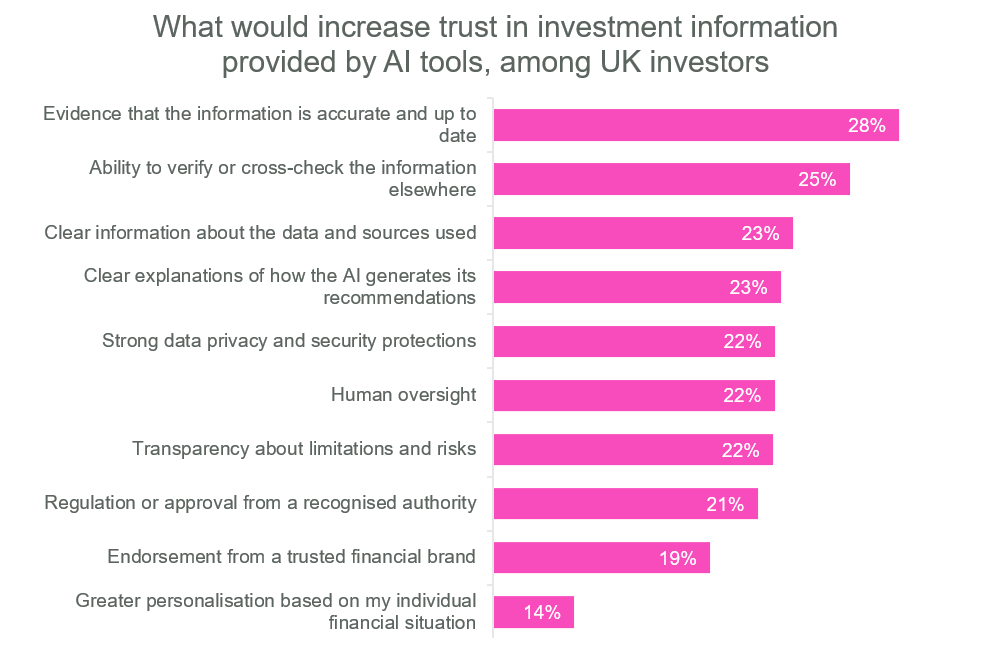
AI guidance is clearly trusted and valued by a significant proportion of the investor community. However, AI tools need to continue evolving to maintain this trust. Providing evidence that information is accurate (28%) is the most important factor in increasing trust in AI-generated insights. This is followed by the ability to verify information independently (25%) and greater transparency around data sources (23%).
Interestingly, personalisation ranks lowest among the factors that would increase trust. Despite the broader trend towards more personalised customer experiences, investors do not yet appear to prioritise this in the context of AI-driven information. Instead, they are focused on transparency, accuracy, and the ability to verify information.
Looking ahead, demand for personalisation is likely to grow as AI tools become more sophisticated. However, for now, investors remain primarily concerned with receiving information that is accurate, credible, and easy to validate.
This research was run on our Opinium Consumer omnibus collecting responses from 2,000 nationally representative UK adults, of this 2,000 UK adults we achieved 836 retail investors. Fieldwork took place between the 9th and 12th June 2026.