


A fatally wounded premiership?
James Crouch takes us through the depths of Keir Starmer’s unpopularity.
As originally seen in Lansons-Opinium Political Capital. The latest polling was conducted between 11th and 15th September 2025 amongst a sample of 2,011 GB adults. See the full data tables here.
Over the weekend, Keir Starmer’s net approval rating fell to a remarkable new low: net -46. While you might expect us to talk about Trump this week, after years of looking at these numbers it’s easy to lose sight of what they mean, but Starmer’s ratings really are extraordinary. That level of unpopularity is unremittingly bad and what’s striking is that we’ve almost forgotten how we got here.
When past prime ministers have sunk to such depths, the reasons were obvious. Liz Truss will forever be associated with the “mini-budget,” a catastrophe that sent markets into panic and destroyed her premiership in a matter of weeks. Boris Johnson will always have Partygate. Rishi Sunak’s peak will always be D-Daygate. With Theresa May’s it’s almost hard to narrow it down to which high-drama Brexit vote eroded her authority most. But Starmer’s tenure doesn’t feel like it has a single defining calamity. Nothing he’s faced has been quite as sharp or dramatic, and yet his unpopularity now seems like an unmovable fact about his time in Downing Street.
It’s worth taking a step back to appreciate just how bad net -46 really is. To put it into perspective (let’s leave Liz Truss aside, her numbers break the scales) and look at Johnson and Sunak, both of whom proved the adage that all political careers end in failure. Johnson was, for most of his time in office, remarkably popular by subsequent standards. He always had a sizeable, loyal base. It was only after the full weight of the first Partygate revelations that his approval hit net -42. Even then, he partially recovered, climbing back to around net -24 before the final collapse of his government (when he slammed back down to net -44). For Johnson, being in the -40s was the aberration, not the norm.
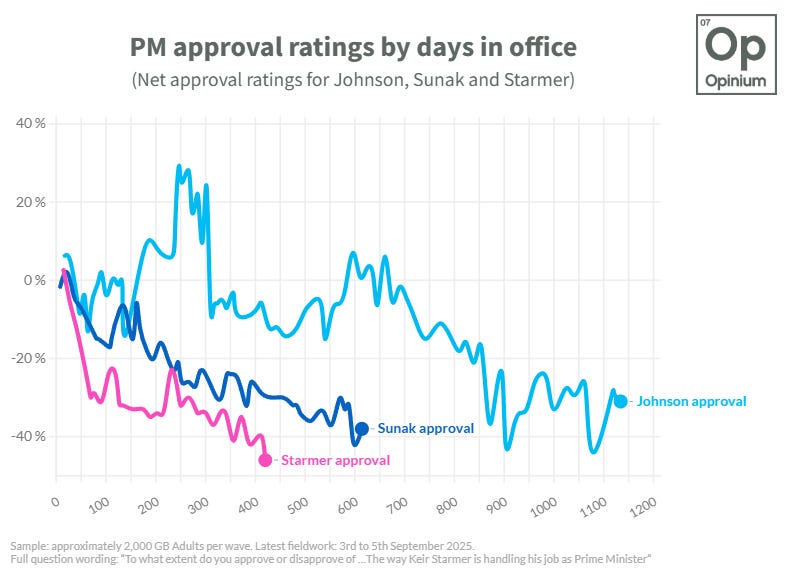
Sunak’s story is slightly closer to Starmer’s. Rather than a single dramatic collapse, his popularity eroded gradually, week by week, month by month. Aside from a brief boost around the Windsor Framework, his premiership was a slow-motion slide into unpopularity. By early 2024, he was stuck at around net -30 and drifting lower. Even his final, disastrous fortnight (dominated by D-Daygate) only saw him hit net -42, never worse.
Which brings us back to Starmer. His trajectory looks different again. There was no single cataclysmic moment that destroyed him. Yet the seeds of decline were planted astonishingly early. Starmer entered Downing Street with positive approval ratings but within two months he had already fallen to net -30. For Sunak, that took nearly a year. For Johnson, it required the biggest political scandal of his career (and even then, not for long).
What happened in those first two months now looks decisive. Starmer’s government opened with deeply negative messaging about the economy, talking up an alleged “black hole” in the public finances and laying the groundwork for a deeply austere budget. That rhetoric spooked consumer and business confidence and made the government sound fatalistic rather than ambitious. Then came the decision to means-test winter fuel payments, a policy that may have sounded like it didn’t break any election promise, but which landed incredibly badly politically, especially given how little groundwork had been laid with the public or even Labour’s own MPs. Amongst a backdrop of freebie-gate the idea that this was a government that said one thing at the election and then just did another once in office was baked in very early.
On top of this came an early, damaging row over the sidelining of Sue Gray, a controversy that undermined the sense of competence the government had hoped to project. None of these crises were individually fatal. But together, they set the tone for Starmer’s administration: an incompetent and out of touch government shockingly far away from the campaign it had just fought.
From there, Starmer’s approval ratings entered a slow but steady decline, interrupted only by a couple of modest attempts at recovery which never had a lasting positive impact on his popularity. Through late 2024 and into 2025, he dawdled in the low -30s. Then came the summer. Angela Rayner’s resignation, followed by Peter Mandelson’s departure, is what lays behind the latest severe damage and brought him to net -46. But even before those resignations, Starmer was already on net minus forty-something, a level that, for Johnson and Sunak, marked an absolute code-red crisis point.
The brutal reality is that Starmer is now more unpopular than Johnson or Sunak ever were at their worst moments. And unlike them, there’s no single scandal or singular moment to blame. Instead, the story of Starmer’s premiership so far is one of a government that set the wrong tone early, undermined its own credibility, and never found a way to reset (successfully, sorry ‘Phase 2’). While you should never say never in politics, and calling his premiership fatally wounded feels premature, net -46 is not just another bad poll. It’s a flashing red warning sign that this government’s authority is deeply wounded.