

Account 2 Account Payments
Project details: An Opinium Thought leadership piece by Sarah Hawley and Tom Cox | Based on a Nat Rep of 2,000 | Fieldwork dates 16th June to 19th June
Background & Context
For more than a decade, Account-to-Account (A2A) payments have been portrayed as the next major evolution in payments. Yet despite strong industry interest, regulatory support and the success of real-time payment schemes around the world, a critical question remains: have consumers caught up with the opportunity?
A2A payments are, at their simplest, the movement of money directly from one bank account to another. They encompass a range of payment mechanisms including traditional bank transfers, Faster Payments in the UK, SEPA Credit Transfers and SEPA Instant across Europe, ACH transfers in the United States, and increasingly, Pay by Bank experiences enabled through Open Banking in the UK. While the consumer experience may differ, the underlying principle is the same: money moves directly between bank accounts.
The growing interest in A2A stems from its fundamentally different economics. Unlike card payments, A2A transactions do not involve interchange fees and typically require fewer intermediaries, resulting in greater pricing transparency and lower acceptance costs for merchants. This is particularly attractive in sectors with high transaction values or thin margins, including retail, travel, gaming and utilities. As instant payment infrastructure continues to mature, especially through schemes such as Faster Payments in the UK, A2A is becoming an increasingly viable alternative to traditional card-based payments.
Crucially, advances in payment initiation APIs (a way different application or systems communicate and share data with each other) mean that A2A payments can now be embedded seamlessly into digital commerce experiences. Whether within ecommerce checkouts, bill payment journeys, insurance premium collections or loan repayments, Open Banking has enabled direct account payments to replicate many of the convenience benefits traditionally associated with cards.
Globally, the momentum behind A2A is undeniable. Markets such as India and Brazil have demonstrated how real-time account-based payment systems can achieve mass adoption at scale through UPI and Pix respectively. While both markets benefited from strong regulatory intervention and market mandates that accelerated consumer uptake, they have provided a compelling vision of how account-based payments can transform the payments landscape when supported by the right ecosystem incentives.
The UK market now appears to be entering a new phase of development. At the end of January 2026, the Financial Conduct Authority (FCA) and Payment Systems Regulator (PSR) issued a joint statement providing greater clarity around pricing models for commercial Variable Recurring Payments (VRPs). VRPs enable consumers to provide authorised third parties with secure, recurring permissions to initiate payments on their behalf, creating the potential for flexible alternatives to both cards and direct debits. For businesses, the model could offer lower-cost payment collection capabilities.
Momentum has also been reinforced at a policy level. In February 2026, the Bank of England announced plans to consult on new payment approaches that would allow consumers to pay retailers directly from their bank accounts, both online and in-store, as an alternative to existing card networks. As Deputy Governor Sarah Breeden noted, the ambition is to ensure UK consumers have the option to pay retailers directly from their bank accounts alongside traditional card-based methods.
Taken together, these developments suggest that the industry conversation is shifting. The debate is no longer centred on whether A2A payments are technically possible or commercially attractive. Instead, attention is increasingly focused on consumer adoption. Awareness, trust, convenience and willingness to use Pay by Bank services will ultimately determine whether A2A moves beyond a promising alternative into a mainstream payment choice.
Against this backdrop, our latest consumer research, based on 2,000 consumers, explores the current state of consumer awareness, understanding and usage of Pay by Bank and Open Banking -powered A2A payments. The findings provide valuable insight into where adoption stands today, the barriers that remain, and what the industry must do to unlock the next phase of growth.
Awareness and Understanding
Awareness is rising, but understanding is lagging
The findings suggest that awareness of account-to-account payments has reached a tipping point among UK consumers. Nearly six in ten (59%) say they know at least a little about Pay by Bank, compared with 42% for Open Banking and 30% for Pay by Link. Awareness is particularly strong among men and younger adults, highlighting where adoption is likely to accelerate first.
However, the bigger story is not awareness—it’s understanding. While most consumers claim some familiarity with Pay by Bank, only 30% correctly identify it as paying directly from a bank account online. Only a minority (11%) thought it is something that connects to their bank account and is a safe alternative to cards (7%). A further 24% think it is simply a bank transfer, while almost a quarter (24%) don’t know what it is at all.
This points to a key challenge for the payments industry. Consumers are increasingly recognising the term “Pay by Bank”, but many still lack a clear understanding of how it differs from traditional bank transfers or card payments.
Payment Preferences & Behaviour
Awareness does not necessarily translate into usage
Unsurprisingly, cards remain firmly entrenched as the UK’s preferred method for online payments. Debit cards dominate (55%), followed by credit cards (41%), PayPal (38%) and digital wallets (27%). In comparison, just 23% say they use bank transfer or Pay by Bank for online purchases.
This highlights a significant gap between awareness and adoption. While consumers may be increasingly familiar with account-to-account payments, as expected, cards continue to win when it comes to actual behaviour at checkout.
The reason becomes clear when looking at what consumers value most. Security and fraud protection are the leading drivers of payment choice, cited by two-thirds (66%) of consumers, ahead of ease and speed (55%). Among those aged 55+, security becomes even more important, rising to 78%.
These findings suggest that the battle between cards and account-to-account payments is unlikely to be won on speed alone. Consumers already have fast payment options; what they are looking for most is confidence and protection. Cards have spent decades building trust through fraud safeguards, chargeback rights and consumer protections/refunds, giving them a powerful advantage at checkout.
For the Pay by Bank ecosystem, the challenge is therefore not simply encouraging consumers to try a new payment method. It is convincing them that they can achieve the same level of security and peace of mind that they associate with cards. Until that perception gap is closed, awareness is likely to continue outpacing usage.
Among those that have not used Pay by Bank/ Open Banking in the past 12 months, most (61%) say they have never seen it as a payment option, rising to 74% of boomers. A quarter (26%) have seen it but chose not to use it, one in ten (10%) considered using it but decided against it, while nearly one in twenty (4%) tried to use it but didn’t complete the payment.
Usage of Pay By Bank/Open Banking
Usage is growing, but friction remains the next barrier to adoption
One of the most striking findings from the research is that usage of Pay by Bank appears to be significantly higher than awareness alone would suggest. After consumers were shown a clear description of Pay by Bank and Open Banking payments, 51% said they had used the method in the past 12 months.
This suggests that many consumers are already using account-to-account payments without necessarily recognising them as “Pay by Bank”. For the industry, this is an encouraging sign. The challenge may not be getting consumers to try the payment method for the first time but helping them connect existing behaviours with the Pay by Bank proposition.
The findings also reinforce the role of account-to-account payments in everyday money movement. Among those who had used Pay by Bank in the last year, the most common use case was peer-to-peer payments, with one-third (33%) using it to send money to friends and family. Usage is even higher among women (37%) and Boomers (46%).

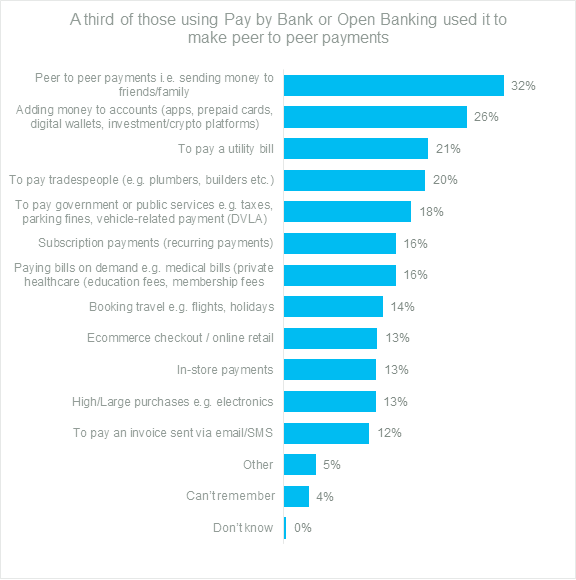
This highlights an important dynamic in the market. Many consumers are already comfortable moving money directly between bank accounts when sending payments to people they know and trust. The opportunity for the payments ecosystem is translating this trust into commercial payment environments, such as online checkout and bill payments, where cards continue to dominate.
At the same time, the results suggest that the user experience still has room for improvement. While a majority (53%) reported encountering no issues, almost half (47%) experienced some form of friction. The leading challenges included being redirected to a banking app (16%), trusting the payment page (15%), understanding the process (14%), authentication steps (14%) and payment speed (14%).
Of those that experienced difficulties when using Pay by Bank/ Open Banking, most said they were at least slightly discouraged from using it again.
These findings point to a critical adoption challenge. The barriers are no longer purely about awareness; they are increasingly about customer experience. Even relatively small points of friction can disrupt payment journeys and reinforce consumer reliance on more seamless card-based methods like Apple Pay.
Interestingly, Boomers were the least likely to report experiencing issues, with 85% saying they encountered none. This may indicate that once consumers understand and trust the process, Pay by Bank can deliver a highly satisfactory experience regardless of age.
The key takeaway is that Pay by Bank has already achieved meaningful consumer usage, particularly for person-to-person payments. The next phase of growth will depend on reducing friction at checkout and building trust in commercial payment journeys, turning a method consumers already use into one they actively choose.
Willingness & Barriers
The challenge isn’t speed – it’s trust
The findings reveal a nuanced picture of the opportunity for Pay by Bank. Consumers are open to using account-to-account payments, but only in situations where trust is already established.
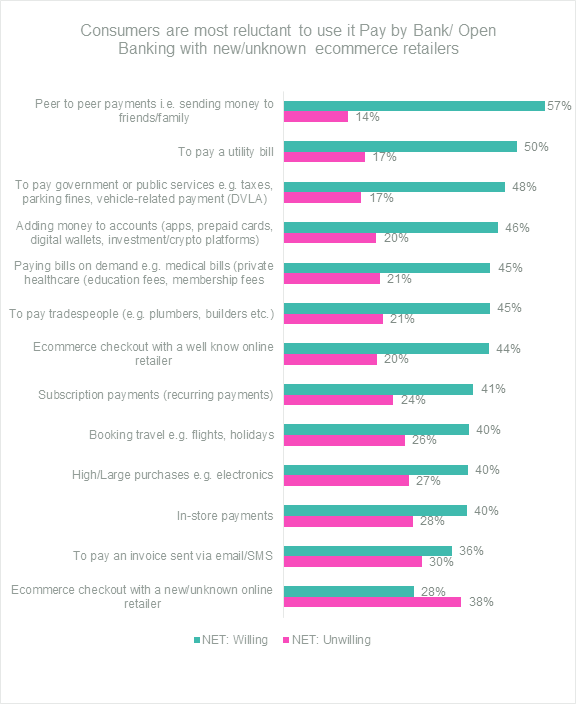
The strongest appetite for Pay by Bank is in scenarios where consumers already feel comfortable moving money directly from their bank account. Nearly six in ten (57%) would be willing to use it for peer-to-peer payments, while around half would consider it for paying utility bills (50%) and government or public service payments (48%). These are environments where the payee is known, trusted and perceived as low risk.
By contrast, willingness drops sharply in situations where trust is less certain. Consumers are most reluctant to use Pay by Bank with new or unknown online retailers (38%), for invoices received via email or SMS (30%), and for in-store purchases (28%). This suggests that the biggest barrier to adoption is not the technology itself, but the level of confidence consumers have in the transaction.

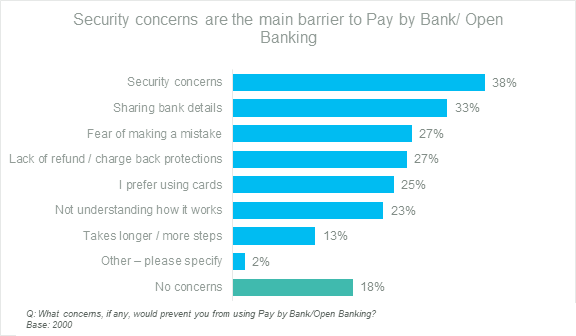
This is reinforced by the concerns consumers associate with Pay by Bank. Only 18% say they have no concerns at all, while security concerns (38%), sharing bank details (33%) and fear of making a mistake (27%) remain significant barriers. Older generations are particularly cautious, highlighting the ongoing challenge of building trust beyond digitally confident early adopters.
Protection beats speed
Perhaps the clearest message for the payments industry is that consumers continue to prioritise protection over speed. While instant payments are valued by a majority (61%), when forced to choose, almost two-thirds (65%) would rather have stronger protection than a faster, more seamless payment experience. Only 20% prioritise speed.
The trade-off becomes even more apparent when consumers consider payment reversibility. As transaction values increase, comfort levels fall dramatically. Nearly two-thirds (63%) would feel uncomfortable making a payment of £500+ if it were difficult to reverse or refund.
This highlights a fundamental challenge for account-to-account payments. Consumers like the idea of instant payments, but not at the expense of the protections they associate with cards. The findings suggest that speed alone is unlikely to drive mass migration away from traditional card payments.
Rewards may be another hidden barrier
The research also points to the power of card rewards programmes. More than half (54%) say cashback, loyalty points or other rewards are important when choosing to pay by credit card, rising among younger consumers and existing Pay by Bank users.
While discounts can encourage some consumers to consider Pay by Bank, expectations are high. Only around three in ten say they would probably or definitely switch if offered a discount, and among those open to changing behaviour, most would require discounts of at least 3-10%, with a quarter needing more than 10%.
For merchants, this raises an important commercial question: can the savings from bypassing card schemes realistically fund the level of incentives consumers appear to need?
The Open Banking opportunity comes with limits
The research also reveals a clear hierarchy of consumer comfort. Around half are comfortable logging into their bank via a secure app (53%) or approving a one-off payment (52%). However, comfort drops significantly when data sharing enters the equation.
Just 31% are comfortable providing one-off access to account information, while only 22% are comfortable granting ongoing access. More than half (53%) are actively uncomfortable with ongoing access to account details.
This suggests that payment initiation may have broader consumer appeal than data-sharing propositions built on Open Banking. Consumers appear willing to authorise transactions but remain cautious about granting access to financial information.
Recurring payments remain the next frontier
Finally, subscription and recurring payment use cases remain relatively underdeveloped. Only 29% would be willing to use Pay by Bank for recurring payments, compared with 33% who are unwilling.
However, the generational split is significant. More than half of Gen Z (51%) would be willing to use Pay by Bank for subscriptions, compared with just 17% of Boomers. Existing users are also far more receptive.
This points to where the market may be heading. Today’s Pay by Bank proposition resonates most strongly with younger consumers and existing users, who place greater value on speed and convenience. For the wider market, however, trust, protection and control remain the dominant decision drivers.
The overarching insight is clear: consumers are willing to embrace Pay by Bank where trust already exists. To truly challenge cards, the industry must focus less on promoting speed and more on replicating the confidence, protections and reassurance that consumers have come to expect from traditional payment methods.
The route to success
The route to adoption is clearer than many think
If there is one overarching lesson from these findings, it is that consumers are not asking for faster payments—they are asking for safer payments.
Across multiple questions, a remarkably consistent picture emerges. Whether considering repeat purchases, switching from cards, or using Pay by Bank more broadly, consumers repeatedly come back to the same themes: protection, trust and control.
When asked what would make them comfortable using Pay by Bank for repeat purchases, the leading responses were guarantees and refund protection (45%) and trust in the provider (42%). Features such as clear control over payments (38%) and easy cancellation (37%) also ranked highly. By comparison, financial incentives (19%) were far less influential.
This suggests that consumers view recurring payments through a risk lens rather than a value lens. The industry often assumes that lower costs or rewards will drive adoption, but consumers are signalling something different: before they think about saving money, they want confidence that they can get their money back if something goes wrong.
Trust beats discounts
The findings also challenge a common assumption that consumers can be easily incentivised away from cards.
While 39% say they would be likely to switch to Pay by Bank if offered a lower price, a deeper look suggests discounts alone are unlikely to transform behaviour. When consumers were asked what would encourage them to use Pay by Bank instead of cards, better security and protection (43%) comfortably ranked ahead of discounts or rewards (29%).
In other words, consumers may be willing to accept a discount, but protection is what truly drives behaviour.
This is particularly important given the role that cards have built over decades. Consumers do not simply use cards because they are easy; they use them because they trust the protections that sit behind them. Any payment method seeking to challenge cards must compete not only on convenience, but also on confidence.
Consumers want Pay by Bank to behave more like a card
Perhaps the most revealing insight comes from the open-ended responses.
When consumers were asked what would need to change for them to switch from cards to Pay by Bank, the dominant themes were security and fraud protection (34%), refund guarantees (21%) and rewards (20%). Respondents repeatedly referenced wanting “the same protection as paying by card”, stronger fraud safeguards and easier refunds.
This is a striking finding for the industry.
For years, discussion around Pay by Bank has focused on what makes it different from cards. However, consumers appear more interested in what would make it feel similar to cards. They are not asking for a fundamentally new payment experience; they are asking for the reassurance they already receive from existing payment methods.
A significant majority remain unconvinced
At the same time, it is important to recognise that a sizeable segment of the market remains resistant.
More than one in five (22%) say nothing would encourage them to use Pay by Bank instead of cards, while 41% say no change would make them switch payment methods. This resistance is particularly pronounced among Boomers, suggesting that some consumers have become deeply attached to the protections, familiarity and habits associated with card payments.
The challenge for the industry is therefore not simply one of awareness or incentives—it is one of behavioural change.
The future of Pay by Bank will be built on reassurance
Taken together, these findings point towards a clear strategic direction.
The next stage of Pay by Bank adoption is unlikely to be unlocked through faster payments, slicker technology or even financial incentives alone. Consumers have consistently told us that the keys to wider adoption are protection, trust, control and refunds.
The opportunity for the payments ecosystem is significant. Consumers are clearly open to the concept, particularly younger generations and existing users. But to move beyond early adopters and challenge cards at scale, Pay by Bank must evolve from being perceived as a faster way to pay to being perceived as a safer way to pay.
The message from consumers is simple: don’t just replace the card transaction—replace the card reassurance.