


Is a low tax offering on the right a viable political option again?
James Crouch, head of policy and public affairs at Opinium, discusses the public’s shifting attitudes towards a low-tax, low-spend economy as we await the Chancellor’s much-anticipated Autumn Budget next week.
Are the British public interested again in a lower-tax and lower-spend economy? Opinium’s latest polling appears to suggest they are, with interest in cutting the size of the state receiving greater support than at any point in the last five years as Budget speculation about tax rises reaches boiling point.
Over the last five years Opinium has tracked public attitudes to tax and government spending in the UK. Should we increase taxes to fund additional government expenditure on public services, or should we cut spending to give space for tax cuts? It’s a question where the public has been divided for quite some time, and more often than not the public has tended to say – either because of their genuine choice or difficulty in choosing between the trade-off – ‘keep levels of tax and spend roughly as they are’.
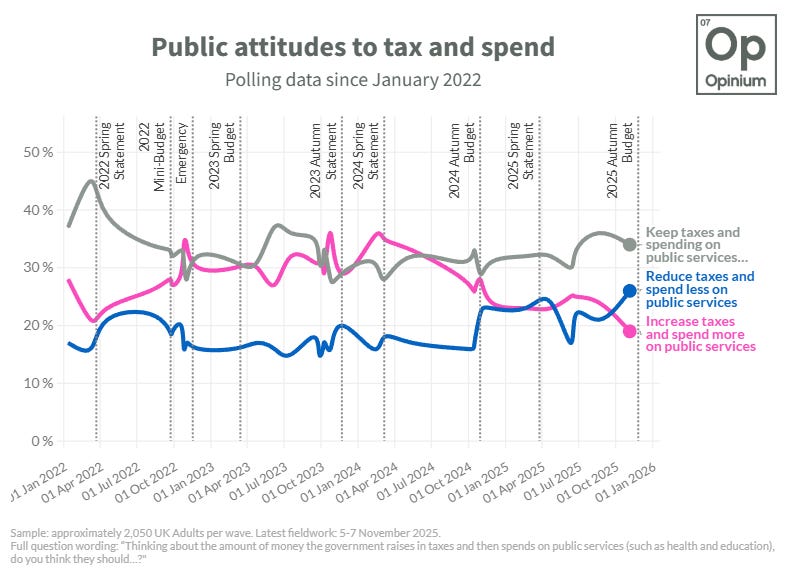
However, it is worth saying that in the post-pandemic era, a smaller state has seemed unviable with the electorate. First, the pandemic itself saw huge rises in spending on services and economic support to deal with a crisis that most people thought was fundamentally necessary, so appetite was limited for tax cuts in 2021 – the year that Rishi Sunak, as Chancellor, raised National Insurance. The acceptance of this high tax take reached its peak in the chart below during the 2022 Spring Statement when 45% of the public essentially said ‘steady as she goes’ with tax and spend in the UK.
The second blow in recent times to the electoral viability of a lower-tax economy was the 2022 Mini-Budget. When Liz Truss came into office in August 2022, support for lower tax and spend reached what was then a peak of 22%, only to fall back to 16% by the time of Jeremy Hunt’s emergency budget that reversed most of the major tax cuts.
Between then and the 2024 general election, the proportion of the public who supported an increase in tax and spending was usually over 30%. In five consecutive polls where we ran this question up until July 2024, hiking tax and spending was the single most commonly selected option; the British public had become tax-and-spend supporters, not small-staters.
However, the latest shifts will challenge Rachel Reeves and give succour to those Conservatives who want the party to position itself as one of low tax.
The run-up to this Budget has been so damaging for the politics of tax rises that our latest poll, conducted 5–7 November, has shown the highest number we have recorded in 36 polls for ‘reduce tax and spend less on public services’, hitting 26%. For the first time in any of our polls, fewer than a fifth (19%) now support hiking taxes to pay for higher spending on public services.
This of course could recede if the 2025 Autumn Budget is less harsh than expected. But we could also be seeing the first signs that the right-of-centre parties will be going into upcoming elections arguing for a popular tax-cutting agenda.
As seen in Lansons-Opinium Political Capital.
Read an article on a similar theme by James Crouch for ConservativeHome: It took Rachel Reeves to make the public consider a lower-tax economy.